First published in
DOI: 10.55593/ej.30118a9
TESL-EJ (The Electronic Journal for English as a Second Language), Vol. 30, No. 2 · August 2026
TESL-EJ (The Electronic Journal for English as a Second Language), Vol. 30, No. 2 · August 2026
Olha Oliinyk and her co-authors examine how gamification affects the motivation and the psycho-emotional state of students learning English in a blended format during the war. At its centre is a pedagogical experiment with a quasi-experimental design: 84 students studied in two groups over 12 weeks. The experimental group worked with game mechanics (Kahoot!, Quizizz, Classcraft, Wordwall and gamified elements in Moodle), the control group followed the traditional methodology. Motivation was measured on a Likert scale and situational anxiety with the STAI-S inventory, and the data were processed with a mixed-design ANOVA.
Both groups showed a rise in motivation and a drop in anxiety, but the changes were markedly stronger in the experimental one. The largest gain in motivation was among first-year students. The authors’ central claim: under wartime conditions gamification works less on academic performance than as an instrument of emotional support, giving the student back a sense of control over their learning and of belonging to a group. At the same time the authors are careful with their conclusions: the sample is small and the design quasi-experimental, so it is too early to speak of cause and effect.
DOI: 10.55593/ej.30118a9
TESL-EJ (The Electronic Journal for English as a Second Language), Vol. 30, No. 2 · August 2026
Gamification is increasingly viewed as a promising approach for supporting student motivation and emotional well-being in crisis-affected educational contexts. This study examines the impact of gamified blended English language learning environments in higher education during wartime in Ukraine. Using a quasi-experimental design, the study involved 84 undergraduate students from a Ukrainian university who were divided into experimental (gamified instruction) and control (traditional instruction) groups over a 12-week period. Data were collected through pre- and post-intervention questionnaires measuring learning motivation (5-point Likert scale) and situational anxiety (STAI-S), supplemented by academic performance indicators and platform activity data. The data were analyzed using a mixed-design ANOVA to examine changes over time and differences between groups. The results suggest an increase in students’ motivation and a decrease in situational anxiety, with more pronounced changes observed in the experimental group. The findings indicate that gamification may contribute to supporting student engagement and emotional well-being in blended learning environments under conditions of instability. These results highlight the potential of gamified approaches for maintaining learning continuity in crisis contexts.
Keywords: anxiety; blended learning; digital educational environments; emotional resilience; gamification; pedagogical experiment.
Modern higher education in Ukraine is experiencing unprecedented challenges associated with the full-scale war, which has affected organizational aspects of the educational process and significantly changed the psychological and emotional state of students. Under martial law, the educational process undergoes significant changes: problems with physical access to institutions, frequent schedule disruptions, and reduced cognitive concentration due to stress and emotional exhaustion (Anishchenko & Kotun, 2024). Against this background, blended learning as a flexible model that combines digital technologies and elements of traditional classroom activities gains particular relevance.
The relevance of the study lies in the need to adapt educational strategies to the conditions of martial law, when psychological instability, stress, uncertainty, and cognitive exhaustion hinder effective knowledge acquisition. Learning English, which ensures academic mobility, access to global resources, and personal growth, requires a pedagogical approach that addresses both educational and psycho-emotional needs. Thus, modern conditions require finding innovative pedagogical approaches that can ensure quality education while supporting students’ motivational potential.
Gamification, which is defined as the integration of game elements into the non-game context of the educational process, demonstrates significant potential in stimulating intrinsic motivation, increasing engagement, and reducing anxiety (Çelik, 2025). Within blended learning, it can act as a key module for enhancing learning activities. Modern studies argue that game elements, including scores, achievements, leaderboards, story missions, and avatars, have a positive impact on intrinsic motivation, reduce the fear of mistakes, and provide a sense of progress and control, which is crucial in wartime conditions (Antonov, 2024). Gamification deepens interest, stimulates cognitive activity, and enhances initiative from the early stages of training (Çelik, 2025). Therefore, exploring gamification in blended English learning during wartime is scientifically, practically, and socially significant.
Although gamification is a relatively new term, it has already garnered numerous interpretations in the literature, most of which emphasize the use of game logic and mechanics to increase efficiency and engagement. Studies confirm that gamified learning promotes long-term retention, quicker acquisition of new material, and higher motivation through visible progress (Lee & Loo, 2021; Bashiri & Ebadi, 2024). In English learning, it supports communicative competence, vocabulary enrichment, and grammar mastery in natural contexts through tasks resembling real communication situations. Gamified activities also develop teamwork, strategic thinking, and cooperation through mechanisms such as badges, rewards, levels, rankings, and progress indicators (Casanova-Mata, 2023; Alibakhshi et al., 2025). Methods such as “Escape Room” create environments for language use and critical thinking, while Mystery Skype fosters metacognitive abilities, real-time communication, and cultural awareness. Platforms like Classcraft add team roles and dynamic feedback through XP, HP, GP, and AR, strengthening student engagement. At the same time, risks such as loss of interest due to repetitive rewards require a balanced approach and regular updates to game elements.
Thus, the object of the study is the process of blended English learning in higher education institutions in wartime, which is considered a complex socio-pedagogical system that combines digital and traditional educational practices. The subject of this study is the theoretical and applied aspects of gamification applied as a tool to increase students’ learning motivation and psycho-emotional resilience during blended English learning in wartime.
This study aims to substantiate the effectiveness of gamification as a pedagogical tool for increasing students’ motivation, engagement, and academic performance when learning English in a blended format in wartime.
The issue of effective use of gamification in the educational process is actively investigated in both foreign and Ukrainian pedagogical science. In scientific discourse, gamification is interpreted as the introduction of game mechanics (scores, levels, competitions, achievements, plots) into a non-game educational context to stimulate learning motivation and student engagement (Werbach & Hunter, 2012; Bi Worldwide, 2025). This is particularly true in the context of blended or distance learning, which has become the norm amid the global crisis, especially martial law in Ukraine.
According to Ryan and Deci (2020), even the most structured environment does not guarantee efficiency without proper internal motivation, the foundation of sustainable learning. Empirical studies confirm that gamification increases students’ interest in learning English, stimulates cognitive activity, and at the same time contributes to reducing the level of anxiety, which is especially important in conditions of war. Considerable attention in foreign sources is paid to the analysis of the impact of gamification on the psycho-emotional state of students. In particular, Deterding et al. (2011) emphasize that gamification contributes to the formation of a safe educational space where the student is not afraid of mistakes. Al-Dosakee & Ozdamli (2021) emphasize the importance of the gamified approach as an adaptation mechanism for universities in crisis circumstances. Similar conclusions are made by Nalyvaiko et al. (2021), who indicate that gamification in the format of project activities activates the cognitive activity of students of pedagogical specialties.
In foreign literature, there are more and more thorough systematic reviews that summarize theoretical approaches and practical models of gamification implementation in the context of teaching foreign languages, in particular English. For example, a study by Al-Dosakee and Ozdamli (2021) presents a structured analysis of more than 40 empirical works in which gamification is used in the educational process. The authors identify general trends, such as the growth in the use of digital gaming platforms (for example, Duolingo, Quizlet, Kahoot!), and also emphasize that the effectiveness of gamification is manifested both in the traditional classroom format and in the remote digital environment. They emphasize that game elements significantly increase students’ intrinsic motivation, especially when combined with adaptive instructional design focused on student autonomy, reflection formation, and emotional inclusion (Al-Dosakee & Ozdamli, 2021).
An in-depth analysis of this topic was also carried out in the work of Yaroshenko et al. (2022), which explores the application of gamification strategies in teaching English in a multicultural academic context. The authors note that gamification performs not only a motivational function but also acts as a tool for intercultural integration, contributing to the construction of a tolerant, open learning environment. Students who participated in the gamified course demonstrated higher levels of interpersonal interaction, greater involvement in group tasks, and lower levels of academic anxiety. This is especially important in conditions of psychological instability inherent in modern educational environments during periods of crisis or hostilities. The main strength of gamification is in the transformation of behavioral models of students: it forms habits associated with systematic repetition, achieving goals, overcoming challenges, and receiving feedback. This is especially important during wartime, when students experience heightened anxiety. Gamification can help reduce this anxiety by giving students a greater sense of control over the learning process, clear opportunities to achieve small successes, and a stronger feeling of belonging to a group (Hamari et al., 2014; Zainuddin et al., 2020).
A special place in the review is occupied by research on digital tools that can be used not only as platforms for learning but also as means of emotional support. In particular, the material “Five creative ways to use Skype in the classroom” demonstrates how the Skype platform can perform not only the function of online communication but also be part of a gamified environment in which students perform roles, perform missions, participate in virtual discussions, and participate in interactive exercises (Nalyvaiko et al., 2021; Sanders, 2025). This contributes to the creation of a learning space where, even online, an element of live interaction is maintained. Similar conclusions are presented in a review of the Adaya Press educational platform, which states that the effective implementation of gamification is possible only if there is a combination of a pedagogical goal and a technical infrastructure capable of maintaining interactivity and continuous feedback (Lopez, 2019).
The works of Ukrainian researchers who analyze the local context of gamification implementation in a crisis are also of significant scientific value. For example, Minenko et al. (2023) draw attention to the differentiated motivation of students of non-linguistic specialties, to whom English often seems secondary. The authors prove that it is gamification that makes it possible to activate interest in the subject and to give it an applied meaning, in particular through simulation games, role-playing situations, and virtual travel. Sheludchenko and Koren (2022) in their publication, focus on tools that have proven effective in domestic higher education, in particular, the use of rating systems, dynamic scores, and open leaderboards that contribute to internal competition and the growth of student engagement. Vorona et al. (2024), in turn, conduct a typology of gamification technologies according to the degree of integration into the educational process and offer a model of a gradual transition from game elements to a full-fledged gamified strategy. Its approach is especially valuable in the context of pedagogical adaptation to war conditions, when educational practices should be not only effective but also psychologically sensitive.
Modern studies show that gamification is part of the broader context of technology-enhanced learning, which combines cognitive, emotional, and behavioral aspects of the educational process. Lin (2025) prove that the effectiveness of digital tools in foreign language learning is directly related to their impact on students’ motivation, anxiety, and engagement. The authors emphasize that the integration of interactive technologies helps reduce speech anxiety but increases students’ confidence in their own communicative abilities. Systematic reviews and meta-analyses further support these findings. Cao and Yu (2023) summarize the results of numerous studies to establish a positive effect of technology-enhanced learning on students’ academic performance, communication, motivation, and emotional state. In turn, Guan et al. (2024) conduct a meta-analysis of the effectiveness of digital tools in English language learning, which demonstrates their significant impact on the development of autonomy, self-regulation, and intrinsic motivation.
The studies by Guo and Wang (2024) and Chen et al. (2025) demonstrate that students’ emotional engagement and readiness for communication increase along with the introduction of AI tools. Derakhshan (2025) emphasizes that generative AI creates a new motivational learning climate in which personalization, immediate feedback, and support for individual learning trajectories play an important role. At the same time, Derakhshan and Ghiasvand (2024) indicate the teachers’ ambiguous perception of such technologies, which requires additional methodological reflection.
Studying technology-enhanced learning, it is also important to analyze students’ emotional experience. Allcoat et al. (2021) argue that virtual and mixed environments increase students’ immersion in learning but can cause cognitive overload. Novak et al. (2023) emphasize that students can easily get frustrated in digital environments, which makes a pedagogically balanced learning design necessary. In this context, gamification acts as a mechanism for balancing complexity and engagement. The social climate of learning is also an important aspect. In a systematic review, Goagoses et al. (2024) argue that interactive and gamified formats contribute to the formation of a positive social environment even in online conditions. Lin and Wang (2024) show that student interaction improves learning satisfaction, supporting the use of team-based game mechanics in gamification.
Furthermore, modern research also draws attention to the challenges of education digitalization. Blackmon and Major (2023) raise the issue of student privacy in digital environments, while Pan and Wang (2025) emphasize the importance of developing teachers’ digital and AI literacy as a prerequisite for the effective implementation of innovations. Similarly, Naeem et al. (2023) emphasize that the effectiveness of technology-enhanced learning depends on a combination of technical, pedagogical, and organizational components. The crisis context significantly transforms learning behavior. Alavi et al. (2022) note that students demonstrate greater adaptability to digital formats but require more emotional support for learning under unstable conditions. This is consistent with the results of the study by Abu Arqub et al. (2024), who emphasize the effectiveness of technology-enhanced learning provided that it is systematically integrated into the educational process.
Yuldasheva et al. (2026) contribute to the scientific discourse by analyzing the practical application of gamification for the development of students’ speech skills. The authors prove that the use of gamified tasks contributes to the activation of speech activity, the development of communicative competence, and increased motivation to learn a foreign language. Particular attention is paid to the integration of game mechanics into the structure of classes, which allows combining educational goals with elements of emotional engagement. The results obtained confirm that gamification is an effective tool for the development of speech skills in a modern educational environment.
In general, the analysis of scientific literature confirms that gamification is not just a fashion trend but a deep didactic approach that allows the integration of cognitive, emotional, and social elements into a single educational process. Its effectiveness is based not only on the attractiveness of the game form, but also on the ability to form positive educational behavior, which is especially important in conditions of military instability, emotional exhaustion of students and the need to adapt the educational process to new challenges of the time. Thus, literary analysis indicates a steady tendency to increase scientific interest in gamification as a tool for pedagogical influence. Despite differences in contexts, most studies agree that gamification has potential not only as a technology that activates cognitive activities but also as a means of emotional support in an unstable external environment, in particular during hostilities.
The methodological framework of this study combined theoretical and empirical approaches to examine the impact of gamification on student motivation and emotional well-being during a crisis. It described the use of analysis of scientific literature, a pedagogical experiment, and standardized questionnaires to ensure comprehensive and reliable results.
The analysis of scientific literature was applied at the initial stage of the study in order to systematize, summarize and critically comprehend scientific publications, monographs and articles related to gamification in learning, student motivation and psycho-emotional state in wartime. Using this method, key trends, theoretical approaches, and gaps in existing research were identified, which made it possible to clearly formulate hypotheses and goals of the pedagogical experiment. This method provided the theoretical basis for the study and became the basis for the development of experimental methods and tools.
The pedagogical experiment was the main empirical method of research and involved introducing gamification into the process of blended English learning. The experimental group of students took a course with game elements, while the control group studied according to the traditional methodology. During the experiment, quantitative and qualitative data on the motivation, anxiety level and academic performance of participants were systematically collected. The selected pedagogical experiment followed a quasi-experimental design with control and experimental groups, as described in the classic works of Campbell and Stanley (1963) and modern studies of the effectiveness of educational innovations (Guskey, 2000). The use of this design was justified by the impossibility of administering a complete randomization of participants in the conditions of the real educational process, which is typical for pedagogical research in higher education institutions.
The questionnaire was used to measure students’ motivation and anxiety quantitatively at the initial and final stages of the experiment. The Likert scale was used to assess academic motivation, and the STAI method helped determine the level of anxiety. The questionnaire was administered anonymously via online surveys. The results of the questionnaire served as the basis for further statistical analysis and assessment of the effectiveness of the implemented methodology. Prior to conducting parametric analyses, normality of the data was assessed using the Shapiro–Wilk test. The results did not indicate significant deviations from normality (p > .05), supporting the use of parametric tests.
The Likert scale was used as a measurement tool for motivational changes in this research, as its sensitivity to changes in attitudes and educational engagement was verified in many studies, including the very first one, “A Technique for the Measurement of Attitudes” (Likert, 1932). The STAI method, a “gold standard” for assessing situational anxiety, was developed by Spielberger (1989); it has repeatedly been used in studies of educational stress and academic anxiety, which ensures the comparability of the results obtained with previous empirical works. The statistical analysis was conducted using a two-way mixed-design ANOVA, with time (pre-test vs. post-test) as a within-subject factor and group (experimental vs. control) as a between-subject factor. The primary focus was on the interaction effect (group × time), which reflects differences in change between groups. Effect sizes were reported using eta-squared (η²).
To assess learning motivation, the authors developed a 12-statement questionnaire, grouped into three subscales: (1) intrinsic motivation and interest in language learning, (2) learning activity and self-regulation, and (3) positive attitude towards the blended learning format. The statements were as follows: “I am interested in completing tasks in English even outside of classes,” “I feel progress in learning,” “Interactive activities increase my engagement.” Responses were recorded on a 5-point Likert scale, where 1 meant completely disagree, and 5 meant completely agree. Although individual Likert items are ordinal, the motivation score was calculated as a composite of multiple items, which allows it to be treated as an approximately continuous variable in line with common practice in educational research.
The reliability of the instrument in this sample was high (Cronbach’s α = 0.86), which confirmed its internal consistency. Situational anxiety was measured using the Ukrainian adaptation of the STAI-S questionnaire (form Y-1, 20 items), where each item was rated on a 4-point scale, and the total score ranged from 20 to 80 (a higher score corresponded to a higher level of situational anxiety). The questionnaire was completed in the 1st and 12th weeks of the semester; the instructions followed a standardized protocol, and the results were interpreted according to Spielberger’s recommendations.
The comparative method was used to analyze the learning outcomes and psycho-emotional state of students of the experimental and control groups before and after the experiment. This method made it possible to identify differences in motivation, anxiety levels and academic performance between groups, which confirmed the effectiveness of gamification as a pedagogical tool.
The stages of the study covered several interrelated areas. First of all, the analysis of modern theoretical approaches to gamification in education and its impact on learning motivation was carried out. In this context, the key concepts of gamification, its difference from game learning, and the features of implementation in the study of foreign languages in accordance with modern literature and empirical reviews were considered. Further, the psychological context of anxiety in students under martial law was investigated. The analysis examined how war affects the psychosocial state of individuals pursuing an education, which decreased their motivation to learn. The analysis also outlined the need for a supportive educational environment that incorporates digital tools.
The pedagogical experiment involved 86 undergraduate students of V. N. Karazin Kharkiv National University, who studied philology (English language and literature), international relations and computer science. The sample included students of 1-3 courses aged 17 to 21, among whom 58% were women (50 people), and 42% were men (36 people). The selection of participants was carried out on a voluntary basis by open announcement among academic groups that had English courses in a blended learning environment. All participants were informed of the purpose of the study, provided written consent to participate, and were guaranteed the right to confidentiality and the opportunity to withdraw from the experiment at any stage.
The distribution of students into control and experimental groups was administered according to the principle of group randomization, taking into account the balance of sex, specialty and training course. The experimental group (44 students) participated in classes that used gamification elements (in particular, Classcraft, Kahoot, Quizlet Live platforms, and game mechanics in Moodle), while the students of the control group (42 people) studied according to the traditional methodology without interactive game tools. Of the 86 students who initially agreed to participate in the study, 84 completed the full cycle of pre- and post-experimental measurements. Two students were excluded at the data collection stage due to the loss of technical ability to participate in online learning and insufficient regularity in class attendance. Thus, further statistical analysis was conducted on a sample of 84 students, which ensured consistency of the reported values and degrees of freedom.
The motivation, situational anxiety (STAI-S), and language proficiency level (entry test A2+) of each participant were evaluated prior to the experiment to ensure equivalence between the control and experimental groups. No statistically significant differences were found between the groups in the pretest (p > 0.05), which allowed for the interpretation of further changes as related to the features of the educational model. In an experimental study, interactive platforms and game tools, including Kahoot!, were used to increase the motivation and reduce the level of anxiety of students in blended English learning, Quizizz, Classcraft, Wordwall, as well as game mechanics integrated into the Moodle learning management system. The duration of the experimental period was 12 weeks (one academic semester). During this time, students of the experimental group participated in regular English classes on a blended learning basis, which involved a combination of traditional lectures, practical classes in the classroom, and online modules with the use of gamification elements.
Each session lasted 90 minutes and had a clearly structured form, as shown in Figure 1.
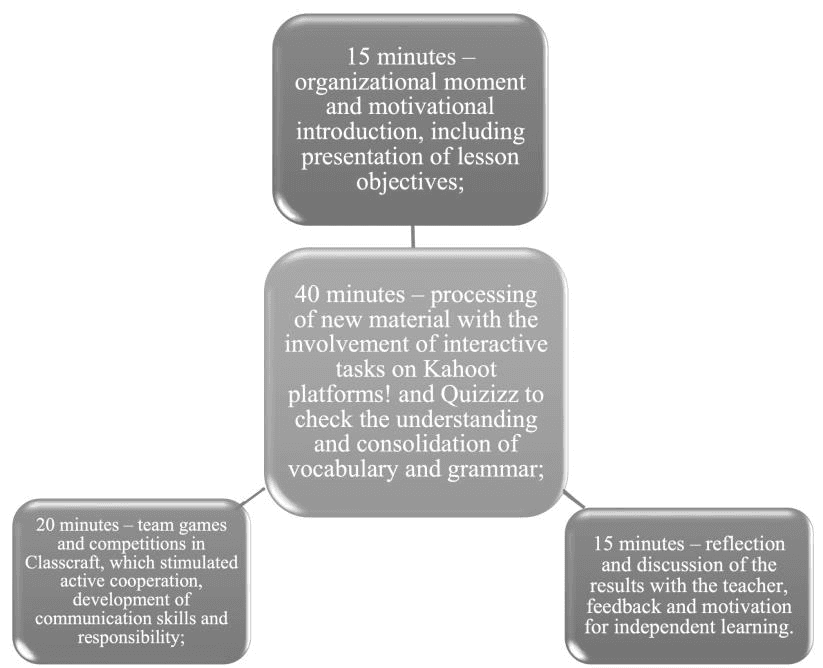
The intensity of gamification application within the experimental group averaged 2-3 interactive sessions per week, which ensured a systematic and sufficient amount of stimulating activity. Measurements of psychological and motivational indicators were carried out by two main tools: a survey using the Likert scale and the STAI (State-Trait Anxiety Inventory) methodology. The questionnaire was conducted twice: before the start of the experimental period (in the first week of classes) and after its completion (the last week of the semester). Data collection was carried out in an online format through a specialized Google Forms platform, which made it possible to ensure anonymity, convenience, and prompt processing of responses. Participants received personal links to the survey, which took place in a calm atmosphere, without unnecessary pressure or influence, which minimized the likelihood of distorted responses.
The STAI technique was used to measure two aspects of anxiety: state (temporal, situational anxiety) and trait (anxiety as a persistent personality characteristic). In this study, attention was focused on the state of anxiety, directly related to the educational process and the students’ psychological state in wartime. Although the STAI instrument conceptually encompasses both situational and personality anxiety, this study used only the STAI-S scale (form Y-1), which corresponded to the focus on short-term changes in psycho-emotional state. The results were analyzed by comparing the mean scores before and after the experimental period, and the changes were interpreted taking into account the level of statistical significance (p < 0.05).
The effect of gamified learning was evaluated using a mixed-design ANOVA framework, focusing on the interaction between group and time. This approach allows for a statistically appropriate analysis of repeated measurements and avoids multiple comparison issues associated with separate tests. Conceptually, the interaction effect corresponds to the difference in changes between groups (similar to a difference-in-differences estimate), but it was tested within the ANOVA framework.
The unstructured pedagogical observation of the course of educational sessions was conducted in this study. Observations were neither used as a separate data collection method nor subject to formal coding, but had an auxiliary, interpretative nature in order to contextualize the quantitative results.
The absence of a formal ethics committee within the educational institution is considered an institutional limitation, but all research procedures complied with generally accepted ethical standards. This study followed the principles of the Declaration of Helsinki and the ethical recommendations of the American Psychological Association (APA). All students participated in the study on a voluntary basis and provided informed consent for the processing of their anonymized data. Participants were guaranteed the right to withdraw from participation at any stage without academic or other negative consequences.
The teachers who conducted the classes and participated in pedagogical observations were responsible for organizing the educational process in accordance with a unified program and did not perform individual psychological assessments of students. Their involvement was based on the principle of professional voluntariness. All data were collected and stored in accordance with principles of confidentiality and anonymization.
In general, the described methodology provided a high level of data quality control and made it possible to comprehensively assess the impact of gamification technologies on the motivation, anxiety and academic results of students in real conditions of blended learning.
A two-way mixed-design ANOVA was conducted to examine the effects of time (pre-test vs. post-test) and group (experimental vs. control) on students’ motivation. A significant main effect of time was observed, F(1,82) = 45.21, p < .001, η² = .36, suggesting an overall increase in motivation across the sample. The main effect of group was not statistically significant, F(1,82) = 1.12, p = .29. The statistically significant result was found in the interaction between time and group, F(1,82) = 10.30, p = .002, η² = .11, suggesting the greater increase in motivation of the experimental group (Table 1).
| Variable | Group | Pre-test M (SD) | Post-test M (SD) | N |
|---|---|---|---|---|
| Motivation | Control | 3.20 (0.70) | 3.50 (0.68) | 42 |
| Motivation | Experimental | 3.20 (0.75) | 4.20 (0.65) | 42 |
| STAI-S | Control | 52.0 (7.0) | 48.0 (6.5) | 42 |
| STAI-S | Experimental | 52.0 (6.8) | 41.0 (5.4) | 42 |
Table 1 presents descriptive statistics (means and standard deviations) for motivation and situational anxiety in both groups before and after the experimental exposure. These values describe changes observed within each group over time and should be interpreted as descriptive rather than inferential. Thus, both groups demonstrated an increase in motivation and a decrease in situational anxiety over time. The magnitude of these changes appears larger in the experimental group; however, differences between groups are evaluated using inferential analysis presented below.
A similar analysis was conducted for situational anxiety (STAI-S). A significant main effect of time was found, F(1,82) = 52.40, p < .001, η² = .39, which points to an overall reduction in anxiety levels. The main effect of group was not statistically significant, F(1,82) = 0.98, p = .32. The interaction effect was statistically significant, F(1,82) = 11.90, p = .001, η² = .13, showing that reductions in anxiety were greater in the experimental group. These findings suggest that gamified learning is associated with differences in change over time between the experimental and control groups. At the same time, it should be noted that the analysis did not include multilevel or cluster-adjusted models, which may limit the generalizability of the results.
To provide additional context, motivation scores were also examined across subgroups defined by course level. In general, n = 84 students took part in the study, which were divided into subgroups according to the course of study. To assess the level of motivation, a scale from 1 (completely disagree) to 5 (completely agree) was used, along with standardized methods to determine the level of situational and personal anxiety. The questionnaire was carried out in an online format using Google Forms in closed access. Students performed it independently in the allotted time in the classroom under the supervision of the teacher, which provided unified conditions for data collection (Table 2).
| Student group | Pre-test M (SD) | Post-test M (SD) | Change (Δ) | Comments |
|---|---|---|---|---|
| All participants (n=84) | 3.20 (0.74) | 4.10 (0.67) | +0.90 | Overall increase observed |
| Course 1 (n=32) | 2.90 (0.71) | 4.30 (0.63) | +1.40 | Larger increase observed |
| Other courses (n=52) | 3.40 (0.76) | 3.90 (0.69) | +0.50 | Moderate increase observed |
As shown in Table 2, increases in motivation appear more pronounced among first-year students compared to students of other courses. This pattern may reflect differences in initial engagement levels or responsiveness to interactive learning formats at earlier stages of study. However, these subgroup differences were not examined within the main ANOVA model and should be interpreted as descriptive rather than inferential. Therefore, while the observed pattern provides additional context, it does not constitute independent statistical evidence.
The answers to open-ended questions supplemented the quantitative results with qualitative information: most students indicated that game elements such as Kahoot!, Quizizz, Classcraft, evoked positive emotions, promoted involvement in the educational process, and increased interest in repeating the material and mastering lexical and grammatical structures. These observations appear consistent with previous research on the role of gamification in enhancing motivation (Ryan & Deci, 2020; Al-Dosakee & Ozdamli, 2021; Boychenko, 2024).
An increase in student involvement was observed during the implementation of gamified activities. Platform activity data (Quizizz, Wordwall, Classcraft), which was estimated based on platform log data comparing the number of completed tasks across groups, suggest an increase in the number of completed tasks compared to traditional formats. The number of students who voluntarily participated in additional educational games and competitions also increased significantly, which may reflect increased engagement and interest in learning activities. Teachers noted more positive dynamics of group interaction, active discussion, and cooperation between students, which was made possible by the introduction of game mechanics of team standings and awards.
An important result of the experiment was also a decrease in the level of situational anxiety, which is especially important in martial law. Descriptive data showed that the average anxiety score decreased from 52 to 41 points in the experimental group. Participants reported that gamified tasks helped them to maintain focus on learning materials and provided a sense of support from both the teacher and peers. This appeared particularly relevant for students who had previously experienced higher levels of academic anxiety related to uncertainty and stress caused by war. These observations appear consistent with previous research suggesting that gamification and emotional support may contribute to reduced anxiety and improved engagement under stressful conditions (Minenko et al., 2023; Chakalov, 2024; Shymanovych & Khalabuzar, 2023).
In addition to psycho-emotional indicators, the study also considered academic performance. The average score in the experimental group was approximately 12% higher than in the control group. These values were calculated based on average scores obtained from course assessments. A more pronounced improvement was observed among students with an initially lower level of knowledge, which may reflect the potential of gamification to support learners at earlier stages of study (Table 3). These observations appear consistent with previous research suggesting that gamification can be associated with improved learning outcomes and increased engagement (Al-Dosakee & Ozdamli, 2021).
| Parameter | Control group (no gamification) | Experimental group (with gamification) | Percentage difference | Comments |
|---|---|---|---|---|
| Average score for the control work | 72% | 84% | +12% | Higher average scores observed in the experimental group |
| Improvement among students with a low level of knowledge | Moderate | More pronounced | - | Greater improvement observed among lower-performing students |
Changes in academic performance indicators (an increase in average values by approximately 12%) were descriptive in nature and reflected a supportive result. Within the framework of this study, academic performance was not defined as a primary outcome indicator but illustrated the general dynamics of educational activity.
A qualitative analysis of the answers to open-ended questionnaires also revealed a number of valuable aspects. Students described gamification as creating a more engaging and interactive learning environment, where tasks were perceived as more meaningful and less routine. Students also referred to elements such as competition, leaderboards, and rewards as contributing to their sense of involvement and satisfaction. In addition, some participants noted improvements in development of self-control skills, responsibility for their own learning and cooperation with classmates. The “activity on platforms” indicator was defined as the number of completed online tasks per student during the semester, based on log data from Quizizz, Wordwall, and Classcraft. Comparisons between groups showed higher levels of activity in the experimental group (Table 4).
| Parameter | Measurement method | Before the experiment | After the experiment | Percentage change/Comment |
|---|---|---|---|---|
| Level of learning motivation | Questionnaire (Likert scale) | 3.2 | 4.1 | Increase in average scores |
| Activity in completing tasks | Platform statistics (Quizizz, Wordwall) | Baseline | Higher activity observed | Suggests increased engagement |
| Student anxiety level | STAI questionnaire | 52 | 41 | Decrease in average scores |
| Academic results | Tests | 72% | 84% | Higher average scores observed |
| Participation in additional activities | Teacher observation | Low | Higher participation | Increased involvement observed |
| Attitude towards learning | Open-ended responses | ~55% positive | ~85% positive | More positive perceptions reported |
However, it should be noted that the indicators presented in Table 4 are descriptive in nature and were not subjected to formal statistical testing; they served as an additional indicator of student engagement.
At the same time, several challenges related to the implementation of gamified learning were identified: some participants noted the need for additional training in the use of digital platforms, as well as the importance of adapting game elements to the characteristics of specific student groups. These observations highlight the role of instructional support in the effective integration of gamified practices.
Consequently, the results of the study suggest that gamification in blended English learning is associated with increased motivation, reduced anxiety, and higher academic performance in this sample. The use of game elements appears to support a more interactive and supportive learning environment, which may be particularly relevant in crisis conditions.
The novelty of this study lies in examining students’ learning motivation and situational anxiety in gamified blended English learning environments in higher education during wartime in Ukraine. The study draws on established theoretical models of motivation and gamification, with its primary contribution being empirical. The results should be generalized with caution due to the limited sample size (n = 84), the possible influence of educational policy, the level of digital accessibility, and the intensity of gamification use. In this article, gamification is rather defined as the use of game elements in a non-game learning environment than full-fledged game-based learning. Escape Room or Mystery Skype formats are not the core of the intervention but serve only as examples. The study’s results are compared with modern systematic reviews and meta-analyses on L2 gamification and learning anxiety to interpret the identified effects as compatible with international trends, and the wartime context may increase the practical relevance of these findings.
The study’s results confirmed the first hypothesis: the gamified approaches used in blended English learning are associated with a statistically significant increase in students’ intrinsic motivation. This pattern is reflected in higher post-intervention scores on the Likert scale, particularly within the experimental group. The results are broadly consistent with the provisions of self-determination theory, which defines intrinsic motivation as a key factor in effective learning (Ryan & Deci, 2020). In this study, academic performance and educational engagement indicators are considered descriptive and do not constitute independent evidence of the intervention effectiveness, which is fundamentally important for the correct interpretation of the results. A more pronounced increase in motivation was observed among first-year students, which may reflect differences in adaptation to the academic environment and responsiveness to interactive learning formats.
The second hypothesis assumed that gamification in wartime performs not only an educational but also a socio-emotional and psychological regulatory function. The observed decrease in situational anxiety in the experimental group suggests that gamified learning may contribute to supporting students’ emotional well-being. In this study, the auxiliary function of gamification was not to improve academic performance but to support students’ emotional state indirectly, including reducing situational anxiety and maintaining a sense of control and social engagement during wartime. Teacher observations, although not systematically analyzed, were generally consistent with the patterns observed in the quantitative data and served to contextualize these findings.
The third hypothesis concerned the integration of gamification into blended learning as a mechanism for creating flexible, adaptive educational environments. The results related to the third hypothesis suggest that the integration of gamification into blended learning may support the development of flexible and adaptive educational environments. The study contributed to sustaining student learning activities amid changes in education format, which is particularly critical in the context of wartime (Bryan & Volchenkova, 2016; Nalyvaiko et al., 2021). In this sense, gamification can be viewed as a tool for increasing the accessibility and inclusiveness of the educational process, as well as developing self-organization and collaboration skills (Yaroshenko et al., 2022).
However, the fourth hypothesis highlighted several limitations related to the implementation of gamified approaches. Interpretive observations made during the course implementation indicated that the uneven level of participants’ digital readiness and the lack of clearly structured methodological recommendations could reduce the effectiveness of using game mechanics (Shlapko & Sokolenko, 2025). These factors were not subject to quantitative analysis but should be considered when further designing gamified educational interventions.
The results should be interpreted within the framework of a quasi-experimental design. While the observed patterns suggest a relationship between the use of gamified learning elements and changes in students’ motivation, anxiety, and engagement, they do not allow for definitive causal conclusions.
Overall, the findings of this study suggest that gamification in blended English language learning is associated with increased motivation, reduced anxiety, and higher levels of engagement in this sample of students. At the same time, achieving sustained outcomes may depend on broader institutional factors, including methodological support, teachers’ digital competence, and access to appropriate technological resources.
This study examined the role of gamification in blended English language learning in a higher education context during wartime. The findings suggest that the use of gamified elements is associated with increased student motivation, reduced situational anxiety, and higher levels of engagement.
The results indicate that changes in motivation and anxiety over time differed between the experimental and control groups, with more pronounced improvements observed in the gamified learning environment. These patterns are consistent with theoretical perspectives emphasizing the role of intrinsic motivation and interactive learning in supporting educational outcomes. In addition to the main findings, descriptive indicators such as academic performance and platform activity suggest broader patterns of student engagement. Although these measures were not included in the main inferential analysis, they provide additional context for understanding the potential impact of gamification on learning processes.
From a practical perspective, the findings highlight the potential of gamification to support student learning and emotional well-being, particularly in conditions of instability. The integration of interactive elements appears to contribute to maintaining student engagement and creating a more supportive learning environment. At the same time, the results should be interpreted within the limitations of a quasi-experimental design. The study did not include multilevel modeling or cluster-adjusted analyses, and some indicators were descriptive in nature. In addition, qualitative data were not formally coded, which limits their interpretability.
Future research may benefit from larger and more diverse samples, the use of multilevel analytical approaches, and the formalization of qualitative data analysis. Further studies could also explore the differential effects of specific gamification strategies across various educational contexts.
Olga Oliinyk, Ph.D. is an Associate Professor at the Department of Psychology, Pedagogy, and Philology, Faculty of Cultural Studies and Social Communications, Kharkiv State Academy of Culture, Ukraine. Her research interests include English language teaching methodology, multilingual education in wartime conditions, the use of digital technologies in education, and social communication in learning environments. ORCID ID: 0000-0002-4224-7269
Nadiya Bevz, Ph.D. is an Associate Professor at the Department of Psychology, Pedagogy, and Philology, Faculty of Cultural Studies and Social Communications, Kharkiv State Academy of Culture, Ukraine. Her research interests include foreign language teaching methodology, hermeneutics, and the philosophy of translation. Her recent work also focuses on multilingual education and the adaptation of foreign language courses to the needs of internally displaced persons in conflict conditions. ORCID ID: 0009-0006-0167-9889
Inna Derevianko is a Senior Lecturer at the Department of Psychology, Pedagogy, and Philology, Faculty of Cultural Studies and Social Communications, Kharkiv State Academy of Culture, Ukraine. Her academic interests focus on pedagogy, multilingual education, and innovative approaches to foreign language teaching in higher education. She is particularly interested in the development of communication skills in multilingual learning environments and the adaptation of educational practices to contemporary social challenges. ORCID ID: 0000-0001-5845-2868
Igor Shuliakov is a Senior Lecturer at the Department of Foreign Philology and Translation, Academic and Research Institute of Economics and Management, O.M. Beketov Kharkiv National University of Urban Economy, Ukraine. His research interests include pedagogy, cultural studies, foreign language teaching, and translation studies. His recent academic work examines multilingual education and the role of communication-oriented approaches in foreign language learning. ORCID ID: 0000-0003-2077-1972
Oliinyk, O., Bevz, N., Derevianko, I., & Shuliakov, I. (2026). Gamified English language teaching in higher education in the context of war: Motivational and psycho-emotional aspects. TESL-EJ, 30(2), 1–18. https://doi.org/10.55593/ej.30118a9

Co-founder of the school, teacher
31years of teaching experience
PhD, holder of the top global certificates CELTA and TESOL, graduate of prestigious US programmes (Universities of Arizona, Oregon, George Mason), a certified trainer of the US Embassy and a speaker at the international TESOL and IATEFL conferences.
25years of teaching experience